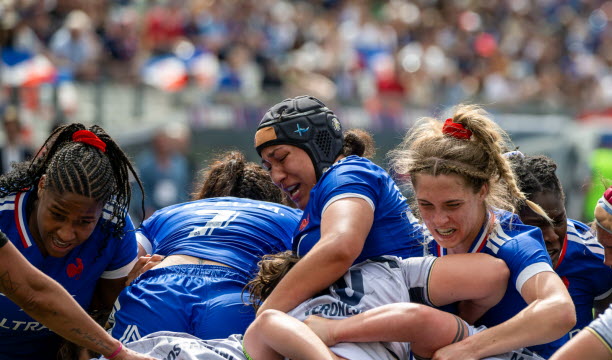
World Rugby has been explicit for years: the scrum cap is approved to limit cuts, abrasions and cauliflower ear, and nothing beyond that. Its regulation claims no protective effect against concussion, and its spokesperson restated the position publicly when studies appeared to suggest otherwise, pointing out that the measures which genuinely reduce head injury are tackle technique and the strict sanctioning of dangerous play rather than equipment.
Mike Loosemore, a leading figure in British contact-sport medicine, has described the mechanism that makes this more than a technical footnote. It is called risk compensation: a player who feels protected takes more risk than a player who knows they are wearing nothing. The cap produces a sense of safety, and that sense sends the head into positions a bare-headed player would instinctively avoid. Loosemore has gone as far as describing some caps marketed for children as potentially dangerous, on the grounds that the equipment alters behaviour considerably more than it alters the impact absorbed.
Work published in BMJ Open Sport & Exercise Medicine shows how unevenly this is understood. Belief in the effectiveness of headgear against concussion is significantly stronger among youth players than among seniors, while the seniors are the ones correctly informed: in club surveys, only around 10% of players give concussion prevention as their reason for wearing a cap, the large majority citing protection against minor injuries, which is what the evidence actually supports.
The organisational parallel
Agility behaves in organisations much as a misunderstood scrum cap behaves on a pitch. The word has been circulating in executive committees for years, sticky notes appear on the walls, meetings become stand-ups and cycles become sprints, and the organisation starts to feel protected against failure in the way a young player feels protected against contact.
None of the underlying practice deserves to be thrown out. A well-built agile frame does organise the rhythm of decisions, regular iterations do get a product in front of its users sooner, progress becomes visible, and a direction can be corrected without waiting for the next quarterly board.
Trouble begins when a team is made to adopt the vocabulary while nobody revisits how decisions travel, who actually needs what, or how departments are supposed to work together. At best the organisation acquires a presentational layer that satisfies people outside it. At worst it loses the caution it would have exercised without the vocabulary, much like the helmeted player charging into contact he would otherwise have avoided. The organisational version of a concussion then arrives as team burnout, as a product answering no real need, or as collaboration broken between departments that completed their rituals without ever properly talking to one another.
What the evidence imposes as discipline
The scientific record on rugby headgear leads to a conclusion that sits badly with corporate communication: a tool protects only what it was designed and tested to protect, never what it was sold or hoped to do. Applied to management, the same discipline rules out adopting a framework because it reassures, and requires adopting it because a precise and identified need justifies it.
Four questions worth answering first
World Rugby names two protective factors that survive scrutiny, a trained technique and an enforced rule. Delivery and impact work have equivalents that are equally well established and equally unspectacular.
Why
Mark Reed, professor and CEO of Fast Track Impact, builds his method on designing impact into a project from the outset rather than reporting it afterwards, starting from a deliberate account of the interests of everyone who holds a stake in the work. A team unable to say in one sentence, in its own words, whose situation improves and how, has nothing on which to base a priority. Commitment from the people doing the work follows from that sentence, and no amount of ceremony makes up for its absence.
What
Scope has to be precise enough that everyone describes it the same way, and divided into pieces small enough to be delivered one at a time. Agile practice contributes something real here, since incremental delivery turns a broad ambition into a series of commitments that can each be tested against reality. What it needs first is a shared understanding of what is included, what has been deliberately left out, and what the first usable piece consists of. Iterating on a scope nobody has defined produces movement without direction.
How
Patrick Lencioni places the absence of trust at the base of his model of team dysfunction, with each layer above it giving way when that base is missing: conflict avoided, commitment withheld, accountability unclaimed, results nobody owns. Amy Edmondson’s research, published in Administrative Science Quarterly in 1999, reaches a comparable conclusion from another direction, showing that a team’s willingness to raise an error or a risk predicts its performance better than the talent it contains. Reed’s relational approach lands on the same ground, treating long-term, two-way, trusting relationships as the condition under which anything changes. Projects seldom derail because nobody saw the problem; they derail because the person who saw it judged silence to be safer. Rituals have little influence on that judgement, while the way leadership responds to the first piece of bad news has a great deal.
When
Every recurring meeting and every report should exist because a named person makes a decision with it. Those that serve no decision can be dropped, and what the people steering the work genuinely need stays, at the frequency they ask for.
None of these four can be settled by announcement. Each calls for a diagnosis, a measurement before and after, and the nerve to withdraw a mechanism that turns out not to work. An organisation serious about delivery and impact gains more from stating the purpose of a single project properly and cutting its governance back to what carries decisions than from rolling out a complete framework across thirty teams.
The scrum cap has its place on a rugby pitch, provided everyone knows precisely what it prevents and what it will never prevent. A working framework has the same legitimate place in an organisation, under the same condition and the same burden of proof.
Bernard Lecuivre runs Coeos Transformation in Brussels and directs the Rugby School of Citizens Brussels, a youth rugby school for players aged 4 to 12 built on a Respect & Plaisir ethos. Fifteen years of programme and transformation management across IBA, RTBF, the Belgian Ministry of Defence, MSF, UCB and the European Commission, with Prince2 Practitioner, Agile PM and Professional Scrum Product Owner credentials.